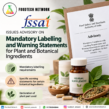
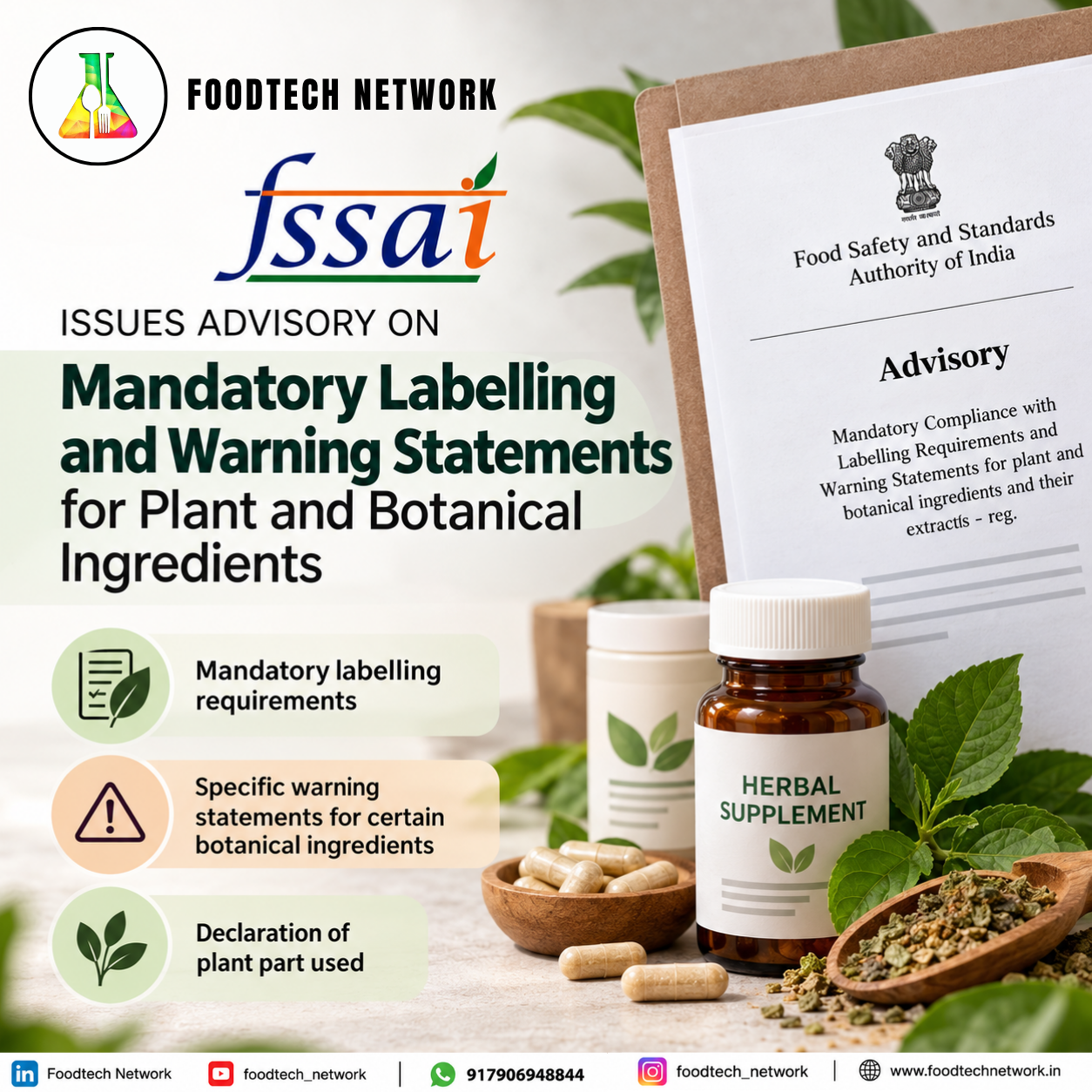
The Food Safety and Standards Authority of India (FSSAI) has issued an official advisory dated 15 October 2026, reinforcing mandatory compliance with labelling requirements and warning statements for products containing plant and botanical ingredients or their extracts.
The advisory, issued by FSSAI’s Regulatory Compliance Division, directs Food Business Operators (FBOs) manufacturing or marketing health supplements, nutraceuticals, foods for special dietary use (FSDU), foods for special medical purposes (FSMP), and other regulated food categories to ensure that their product labels comply with the applicable provisions of the Food Safety and Standards Regulations, 2016.
The move aims to strengthen consumer safety, improve transparency in product labelling, and prevent misleading claims associated with botanical ingredients.
Key Highlights of the FSSAI Advisory
1. Mandatory Warning Statements on Product Labels
FSSAI has observed that several Food Business Operators are not complying with the prescribed labelling requirements and cautionary statements for plant and botanical ingredients listed under Schedule IV of the applicable regulations.
Manufacturers must ensure that the relevant warnings and disclaimers are clearly displayed whenever the specified ingredients or extracts are used in their products.
2. Declaration of Plant Parts Used
Food Business Operators must provide appropriate declarations identifying the plant parts used in their formulations, wherever required under the applicable regulations.
This is particularly important for botanical ingredients, as different plant parts may have different permitted uses and associated safety considerations.
3. Examples of Botanical Ingredients Requiring Cautionary Statements
The advisory and its Annexure I identify several botanical ingredients along with their permitted usage ranges and associated warnings.
Examples include:
- Neem (Azadirachta indica): Certain leaf and fruit preparations carry warnings for individuals planning to conceive. Neem fruit also carries a warning for children below five years.
- Papaya (Carica papaya): Specified unripe fruit and leaf preparations carry warnings against use during pregnancy.
- Coleus (Coleus forskohlii): The listed preparation carries a warning against use in children below five years.
- Coffee (Coffea arabica / Coffea robusta): The specified seed preparation carries a warning against use in children below five years.
- Snuhi (Euphorbia species listed in the advisory): The specified fresh leaf preparation carries warnings for children below five years and pregnant women.
- Hibiscus (Hibiscus rosa-sinensis): The specified flower preparation carries a warning against use during pregnancy.
These are illustrative examples. Manufacturers should consult the complete Annexure I to identify all applicable requirements for their ingredients and formulations.
4. Permitted Usage Limits Must Be Followed
The advisory refers to specified permitted usage ranges for botanical ingredients, expressed in terms of raw herb or material per day for adults.
Manufacturers must verify the applicable ingredient, plant part, preparation form, permitted quantity, and cautionary statement before finalising product formulations and labels.
The specified limits should not be interpreted as general recommendations for self-medication or personal consumption.

5. Review of Product Labels and Formulations
FSSAI has directed Food Business Operators to review their existing product labels and formulations to ensure compliance with the Food Safety and Standards Act, 2006, and the applicable regulations, as amended from time to time.
Businesses should assess whether their products contain any listed botanical ingredients and confirm that the required declarations, disclaimers, and warning statements are present and appropriately displayed.
Regulatory Consequences of Non-Compliance
The advisory states that failure to comply with the prescribed statutory requirements may attract regulatory action.
It refers to Section 23 of the Food Safety and Standards Act, 2006, and identifies Section 52 as a provision under which stringent action may be taken. Depending on the applicable legal provisions and circumstances, non-compliance may also expose businesses to further regulatory action, including action affecting their licences.
Food Business Operators should therefore treat botanical ingredient labelling as an important part of their regulatory compliance and product safety management systems.
What Should Food Business Operators Do Now?
Manufacturers, importers, brand owners, and other relevant FBOs should take the following steps:
- Conduct a label review: Check all products containing plant and botanical ingredients or their extracts.
- Verify ingredient declarations: Confirm that the plant name and plant part used are declared wherever required.
- Check cautionary statements: Match each relevant ingredient against the complete FSSAI Annexure I.
- Verify permitted usage levels: Review the applicable quantity limits and preparation forms.
- Review marketing claims: Ensure that product labels and promotional materials do not make prohibited medicinal or disease-cure claims.
- Update documentation: Maintain appropriate formulation records, label approvals, and compliance evidence.
- Review imported products: Ensure that imported food products also meet the applicable Indian regulatory requirements.
The FSSAI advisory dated 15 October 2026 reinforces the importance of accurate labelling, ingredient transparency, and appropriate cautionary statements for botanical ingredients used in regulated food products.
Food Business Operators should review their formulations and labels against the applicable regulations and the complete Annexure I to ensure that all relevant declarations and warnings are addressed.
📢 Be Aware, We never charge any consultancy fee for jobs.
📲 Foodtech Network WhatsApp Jobs Group
Click to join the WhatsApp group
👥Free Membership (For Jobs, Internship and Training)
Membership registration
⚙️ Food Entrepreneurs & Startups (For business owners)
Our services (Free and Paid)
📱 Food safety training and certification.
Check our training portal and enroll now