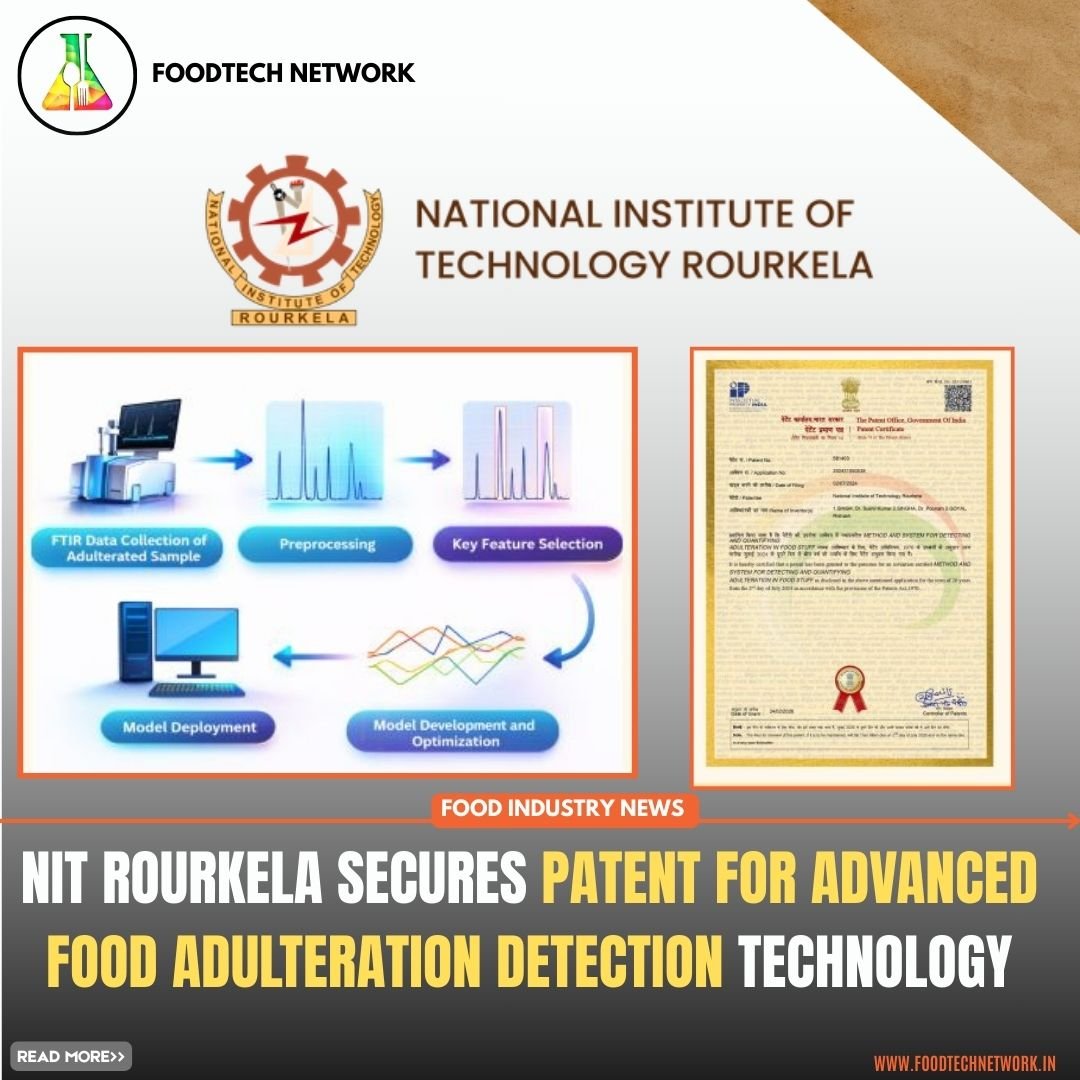
In a significant breakthrough for food safety and quality assurance, the National Institute of Technology (NIT) Rourkela has secured a patent for an innovative technology aimed at detecting and quantifying food adulteration with high precision.
The patented system, titled “Method and System for Detecting and Quantifying Adulteration in Food Stuff,” has been developed by Assistant Professor Dr. Sushil Singh, along with Late Dr. Poonam Singha and M.Tech graduate Mr. Rishabh Goyal from the Department of Food Process Engineering.
This cutting-edge innovation leverages Fourier Transform Infrared (FTIR) Spectroscopy integrated with machine learning models optimized through Bayesian Optimization. Unlike traditional techniques that merely detect the presence of adulterants, this system goes a step further by accurately quantifying the level of adulteration in food products within seconds.
The technology addresses key limitations of existing methods, particularly in terms of computational efficiency and speed, while maintaining high accuracy. This enables food industries and regulatory bodies to quickly assess contamination levels and take timely corrective actions, ensuring better consumer safety.
Experts believe this development marks a major advancement in food quality monitoring, offering a reliable and rapid solution to combat the growing challenge of food adulteration. It is expected to have wide-ranging applications across food processing industries, quality control laboratories, and regulatory agencies.
This achievement further reinforces NIT Rourkela’s position as a leading institution driving impactful research and innovation in the field of food technology.
📢 Be Aware, We never charge any consultancy fee for jobs.
📲 Foodtech Network WhatsApp Jobs Group
Click to join WhatsApp group
👥Free Membership (For Jobs, Internship and Training)
Membership registration
⚙️ Food Entrepreneurs & Startups (For business owners)
Our services (Free and Paid)
📱 Food safety training and certification.
Download our App, Foodtech Network