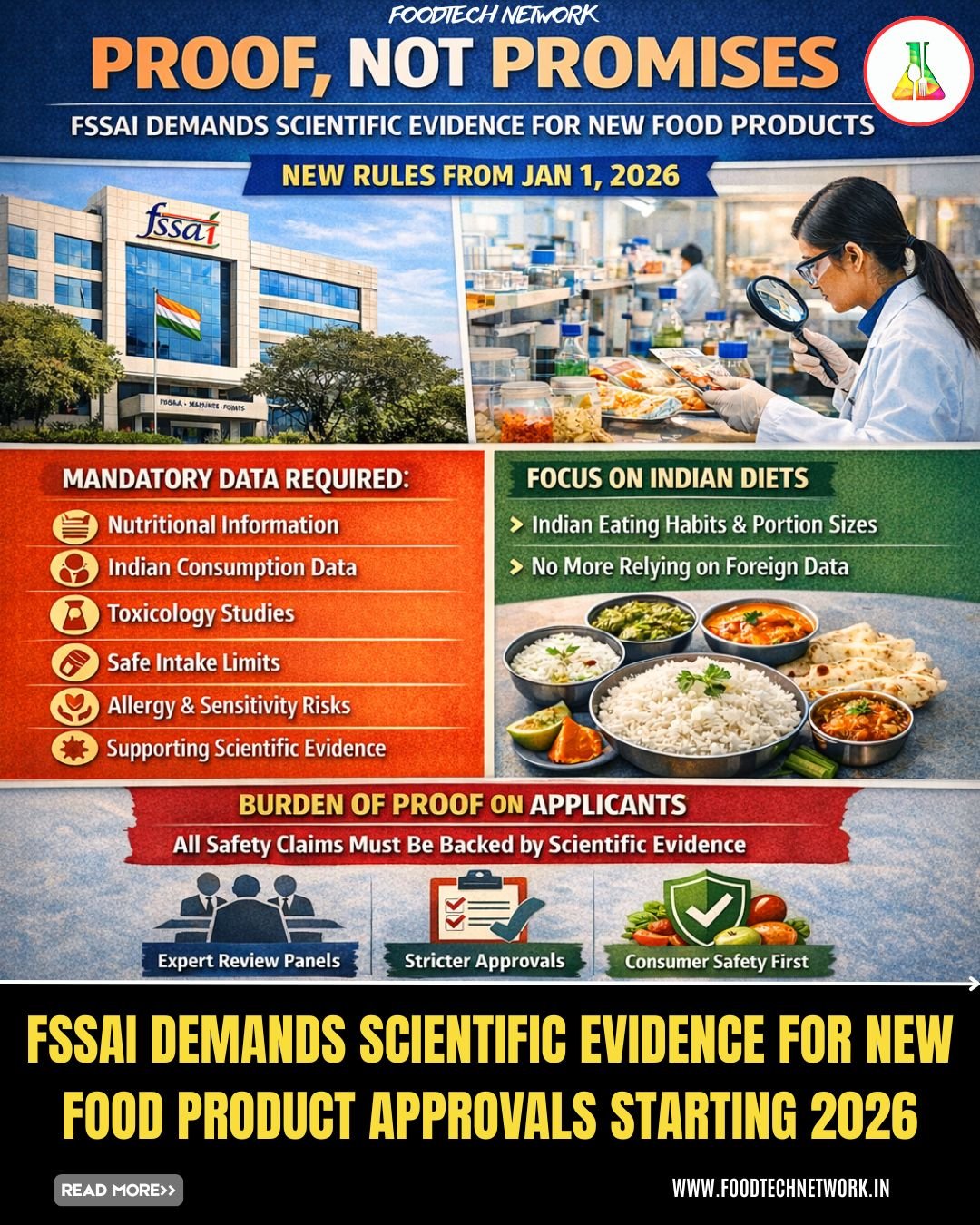
When questions arise about the safety of a food product, India’s food regulator is now demanding hard proof instead of assurances. From January 1, 2026, the Food Safety and Standards Authority of India (FSSAI) has made it mandatory that all requests for food safety reviews or changes in food standards follow a single, standardised format backed by scientific evidence.
What has changed?
FSSAI found that many earlier applications lacked basic data and uniform structure, making scientific risk assessment difficult. Under the new rules, any stakeholder seeking approval for a new food product or a review of an existing one must now submit detailed scientific proof to support safety claims.
Importantly, this does not mean all existing foods will be re-evaluated automatically. The rule applies only when an applicant approaches FSSAI for a scientific risk assessment. In such cases, the burden of proving safety lies entirely with the applicant.
What data will be mandatory?
Under the new framework, submissions must clearly include:
- Nutritional composition of the product
- Consumption patterns specific to Indian diets
- Toxicological study results
- Evidence on safe intake limits
- Allergy and sensitivity risks
- Supporting national or international scientific studies
These submissions will be reviewed by FSSAI’s Science and Standards Division and evaluated by expert panels, which will decide whether a product can be approved, continued, restricted, or subjected to stricter limits.
Why the focus on Indian eating habits?
FSSAI officials stress that reliance on overseas data can be misleading, as Indian food habits, portion sizes, and sensitivities differ widely from other countries. With packaged and processed foods becoming increasingly common, understanding real exposure levels in India is critical for protecting public health.
Experts have welcomed the move, calling it a long-overdue step toward science-based and consumer-centric food regulation. By insisting on long-term safety data and realistic consumption patterns, the regulator aims to make food standards safer and more relevant for Indian consumers.
What it means for consumers
For the public, the message is clear: when food safety is questioned, evidence—not promises—will decide what stays on the plate. FSSAI has also assured stakeholders that all submitted data will remain confidential and be used strictly for scientific evaluation and policy decisions.
This shift marks a significant tightening of India’s food safety regime and signals a stronger commitment to public health in an evolving food market.
📢 Be Aware, We never charge any consultancy fee for jobs.
📲 Foodtech Network WhatsApp Jobs Group
Click to join WhatsApp group
👥Free Membership (For Jobs, Internship and Training)
Membership registration
⚙️ Food Entrepreneurs & Startups (For business owners)
Our services (Free and Paid)
📱 Food safety training and certification.
Download our App, Foodtech Network