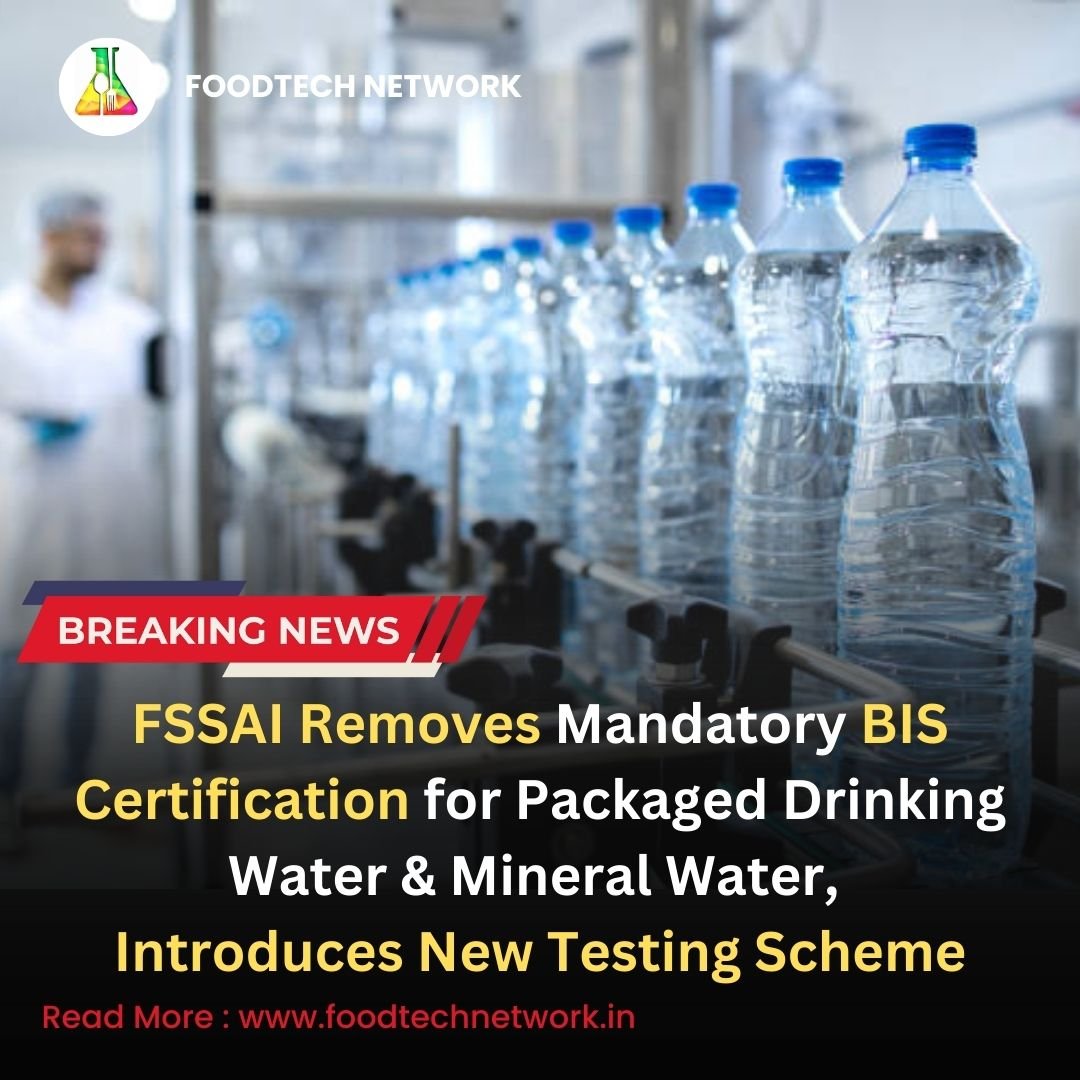
The Food Safety and Standards Authority of India (FSSAI) has officially removed the requirement for mandatory Bureau of Indian Standards (BIS) certification for Packaged Drinking Water (PDW) and Mineral Water (MW). The decision has been notified through a regulatory order dated 17 December 2025, marking a significant shift in India’s bottled water regulatory framework.
As per the notification, the provision mandating the BIS Certification Mark under the Food Safety and Standards (Prohibition and Restriction of Sales) Regulations, 2011 has been omitted with effect from 17 October 2024. Consequently, BIS certification is no longer compulsory for manufacturers of packaged drinking water and mineral water in India.
New Scheme of Testing Introduced
To ensure consumer safety and regulatory compliance following the removal of mandatory BIS certification, FSSAI has introduced a Scheme of Testing for Packaged Drinking Water and Mineral Water. All Food Business Operators (FBOs) involved in the manufacture of PDW and MW are required to strictly comply with this scheme effective from 1 January 2026.
The scheme mandates comprehensive testing protocols covering:
- Microbiological, chemical, and radiological parameters
- Source water testing from FSSAI-notified NABL-accredited laboratories (ISO/IEC 17025)
- Batch-wise testing and record maintenance
- Corrective actions and revalidation in case of non-compliance
- Minimum record retention period of five years
Strengthened Controls on Packaging and Hygiene
The notification reiterates that all packaging materials—including plastic bottles, jars, pouches, glass bottles, cartons, and aluminium cans—must comply with the Food Safety and Standards (Packaging) Regulations, 2018. Specific provisions have also been laid down for reused containers, emphasizing durability, cleanability, and disinfection.
Further, strict hygienic conditions are mandated across the entire production chain—from source water collection and processing to storage, packing, and distribution—aligned with Schedule IV of the Food Safety and Standards (Licensing and Registration of Food Businesses) Regulations, 2011.
Focus on Accountability and Food Safety
FSSAI has made it clear that non-conforming products must be rejected and disposed of in a controlled manner to prevent market circulation. Separate records for rejected batches and disposal methods must be maintained and made available for regulatory scrutiny.
The move is expected to reduce regulatory duplication, ease compliance for water manufacturers—especially small and medium enterprises—while maintaining robust food safety oversight through structured testing and monitoring mechanisms.
Regulatory Oversight
The directive has been issued with the approval of the competent authority and has been communicated to all concerned FBOs, State Food Safety Commissioners, FSSAI-notified laboratories, and licensing authorities.
📢 Be Aware, We never charge any consultancy fee for jobs.
📲 Foodtech Network WhatsApp Jobs Group
Click to join WhatsApp group
👥Free Membership (For Jobs, Internship and Training)
Membership registration
⚙️ Food Entrepreneurs & Startups (For business owners)
Our services (Free and Paid)
📱 Food safety training and certification.
Download our App, Foodtech Network