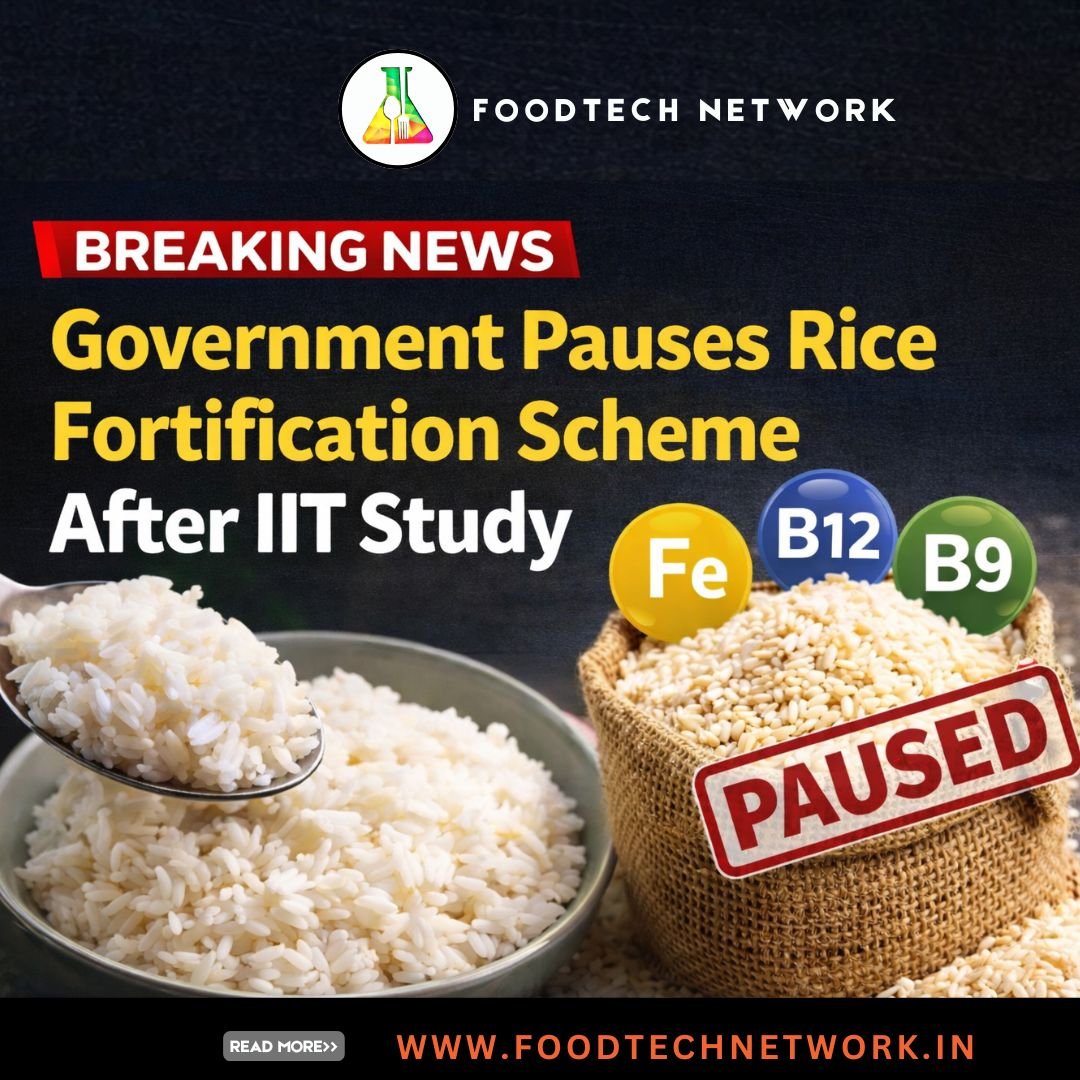
Ministry of Consumer Affairs Food and Public Distribution has announced the temporary suspension of the rice fortification process under major welfare schemes, including Pradhan Mantri Garib Kalyan Anna Yojana, following concerns raised in a study conducted by Indian Institute of Technology Kharagpur.
The decision was taken after reviewing the implementation of fortified rice distribution under various government food programs. According to the Food Ministry, rice fortification will remain discontinued until a more effective mechanism for delivering nutrients to beneficiaries is identified.
Findings from the IIT Kharagpur Study
The study examined the shelf life and stability of fortified rice kernels (FRK) and fortified rice (FR) under real storage conditions across different agro-climatic regions of India. Researchers found that several environmental factors significantly affect the quality and effectiveness of fortified rice.
Key factors influencing the stability of fortified rice include:
- Moisture content
- Storage conditions
- Temperature and relative humidity
- Packaging materials
The report noted that these factors can lead to micronutrient loss and reduced shelf life during prolonged storage and handling, which may limit the intended nutritional benefits of fortified rice.
No Impact on Food Distribution Schemes
The government clarified that the decision will not affect foodgrain entitlements for beneficiaries. Distribution under the Public Distribution System (PDS), Integrated Child Development Services (ICDS), and the Mid-Day Meal Scheme will continue as usual.
Activists Welcome the Move
Several activists and civil society groups welcomed the government’s decision. Social activist Kavitha Kuruganti, who had challenged the scheme in the Supreme Court, said the suspension was a positive step.
She argued that rice fortification is an expensive and ineffective intervention, adding that anaemia cannot always be addressed through iron fortification alone. According to her, many forms of anaemia are not directly linked to iron deficiency, making fortification an incomplete solution.
Kuruganti also noted that a public interest litigation (PIL) had previously been filed in the Supreme Court questioning the scientific and regulatory basis of the large-scale fortification program.
Background
India introduced fortified rice distribution in welfare schemes to combat micronutrient deficiencies such as iron-deficiency anaemia, particularly among vulnerable populations. Fortified rice typically contains added iron, folic acid, and vitamin B12, blended with regular rice through fortified rice kernels.
However, the latest findings and concerns around storage stability and nutritional effectiveness have prompted the government to reconsider the implementation approach.
Looking Ahead
The Food Ministry stated that it will continue evaluating alternative strategies for improving nutrient delivery to beneficiaries while ensuring the effectiveness and safety of nutrition interventions.
The temporary suspension signals a policy reassessment in India’s food fortification strategy, highlighting the importance of scientific evidence, storage stability, and nutritional outcomes in large-scale public health programs.
📢 Be Aware, We never charge any consultancy fee for jobs.
📲 Foodtech Network WhatsApp Jobs Group
Click to join WhatsApp group
👥Free Membership (For Jobs, Internship and Training)
Membership registration
⚙️ Food Entrepreneurs & Startups (For business owners)
Our services (Free and Paid)
📱 Food safety training and certification.
Download our App, Foodtech Network