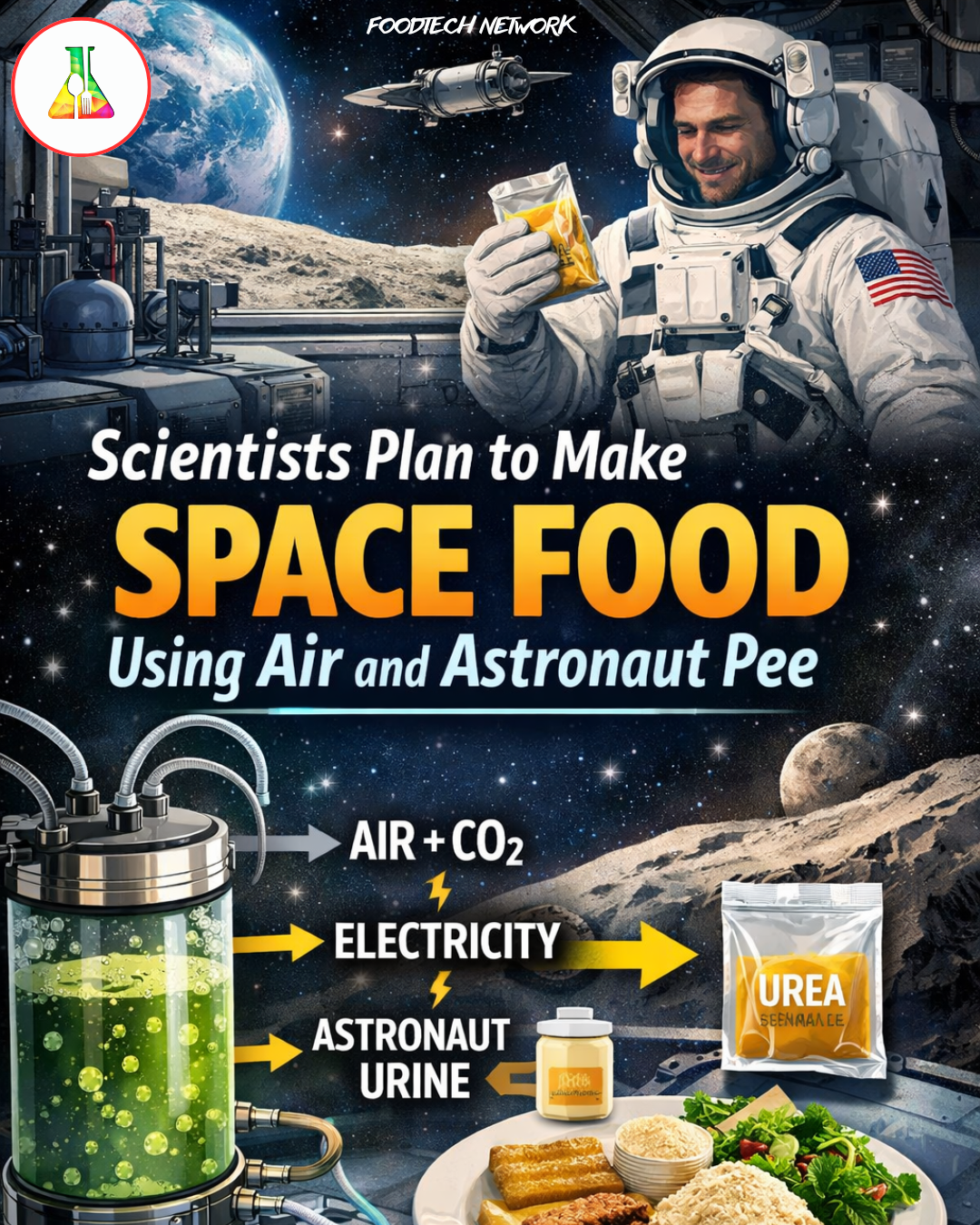
As humanity prepares for long-term missions to the Moon and Mars, one big question keeps coming up: What will astronauts eat on months or years-long journeys?
Scientists may now have a surprising answer — food made from air and even astronaut urine.
The European Space Agency (ESA) has launched an ambitious new project called HOBI-WAN, aiming to create a sustainable food production system for deep-space missions. The goal is to make astronauts more self-sufficient and reduce the need to carry huge amounts of supplies from Earth.
Food Made from Thin Air? Yes — And It Already Works on Earth
Finnish food-tech company Solar Foods has developed a unique protein powder called Solein, made using a special gas fermentation process.
The ingredients?
✔ Microbes
✔ Carbon dioxide from air
✔ Hydrogen and oxygen from water
✔ Electricity
The result is a nutrient-rich, versatile protein powder that can be added to meals, drinks, or used as a base ingredient.
Solar Foods has already demonstrated this technology on Earth. Now, with ESA and OHB System AG, the next step is testing it in space.
Urine As a Key Ingredient — Here’s Why
On Earth, the fermentation process uses a pinch of ammonia as a nitrogen source. But in space, carrying ammonia isn’t practical. Instead, scientists plan to extract urea — a nitrogen-rich compound found in urine — to feed the microbes.
This creative recycling process would help astronauts convert waste into usable food ingredients, enabling long-term survival with minimal resupply missions.
Challenges in Microgravity
Despite the potential, several scientific hurdles remain:
1. Gases and liquids behave differently in space
In microgravity, there is no buoyancy, which affects how nutrients and gases mix and move. This could disrupt the growth of the Solein-producing microbes.
2. Ensuring food safety
Astronauts’ health is critical, so researchers must confirm that the protein produced is:
- Safe
- Nutritious
- Stable
- Tastes acceptable
3. Scaling production
The big goal is not just proving it works once, but ensuring it can keep producing food steadily for months or years.
A Step Toward Space Colonies
ESA’s Chief Exploration Scientist Angelique Van Ombergen explains that innovations like this are essential for future missions:
“Long-duration missions will require sustainable solutions to survive with limited supplies.”
Solar Foods’ senior vice president Arttu Luukanen highlights the historic nature of the project:
“Gas fermentation in space has never been done before in human history.”
If successful, this technology could reshape the future of human space exploration — and even help solve food security challenges on Earth.
📢 Be Aware, We never charge any consultancy fee for jobs.
📲 Foodtech Network WhatsApp Jobs Group
Click to join WhatsApp group
👥Free Membership (For Jobs, Internship and Training)
Membership registration
⚙️ Food Entrepreneurs & Startups (For business owners)
Our services (Free and Paid)
📱 Food safety training and certification.
Download our App, Foodtech Network